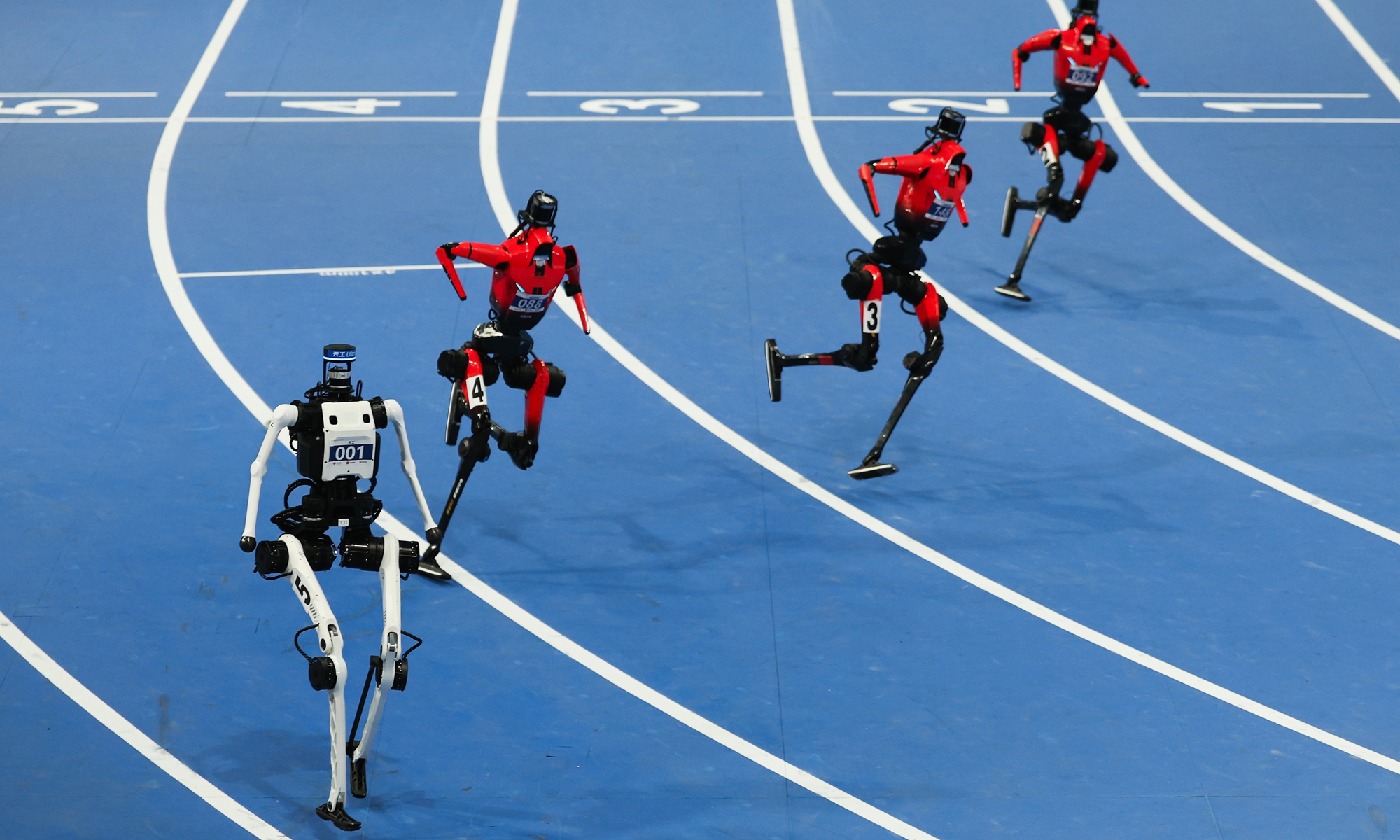
A Tien Kung robot (left) competes in the 400-meter race at the National Speed Skating Oval in Beijing on August 23, 2026 during the 2nd World Humanoid Robot Games (WHRG). Photo: VCG
On the blue track inside the National Speed Skating Oval, robots chased each other in the 400-meter race. A sprinting Tien Kung robot was tripped by a rival robot lying on the track but did not fall. Instead, it adjusted its posture in seconds and continued toward the finish line with a result of 38.15 seconds, breaking human 400-meter race world record of 43.03 seconds, held by South African athlete Wayde van Niekerk. This scene unfolded on Sunday, the first official competition day of the 2nd World Humanoid Robot Games (WHRG). Later that evening, a humanoid robot named Lightning, developed by Honor Co., broke the long-standing human 1,500-meter world record of 3:26 set by Moroccan athlete Hicham El Guerrouj with a time of 2:30.22. Just one night earlier, during the opening ceremony's 100-meter sprint and high jump demonstrations, humanoid robots had already shattered records long held by human athletes Usain Bolt and Javier Sotomayor — merely an appetizer for the five-day sci-fi spectacle. The Games have attracted 666 teams from 16 countries across six continents, up 138 percent from its inaugural edition. The number of participating robots quadrupled to 2,056, the Global Times learned from the organizing committee. Yet the biggest change this year was not only the scale, but also the technological maturity. More teams have shifted from remote-controlled robots to fully autonomous systems. Chinese observers, after watching several events, said humanoid robots are no longer limited to simple demonstrations of walking or dancing. Increasingly, they are being tested in environments that demand speed, coordination, perception and decision-making. From movement to intelligence
Behind the record-breaking performances are a series of technological upgrades. During the running events, Global Times reporters observed that robots were able to make subtle movements around their hip joints while walking, allowing them to maintain balance and produce movements closer to human biomechanics. Guo Yijie, technical director of Tien Kung Ultra, said the improvement came from advances in hardware design. "Robot joints have improved in torque and speed. As competitions demand higher power output, the reliability of the main control board, power board and high-power battery discharge capability have become increasingly important," Guo told the Global Times. According to Guo, the same Tien Kung Ultra robot was used in both sprinting and jumping events. For running, the waist needs rotation to balance the inertia generated by leg movements. For jumping, the upper body requires pitching movement to help the robot achieve greater distance or height, Guo said, noting that these can all be achieved with only slight adjustments to the waist configuration were needed, and it highly demonstrated to the robot design's flexibility. Besides the hardware upgrades, developments in robots' faster decision-making in "brains' is better showcased in football competitions. The Booster T2 robot used by many domestic and overseas football teams has increased its onboard computing capability by 10 times compared with the previous generation. The time from recognizing the goal to deciding whether to pass or shoot has been reduced to around 100 milliseconds - faster than the time humans usually need to blink. Cheng Hao, a technical representative from Boosters Robotics, said the improvement represents an "end-to-end" transformation in embodied intelligence. "In the past, robots relied on separate steps: perception, planning, decision-making and execution. Each stage was disconnected. Now, with an end-to-end motion foundation model, visual input can directly generate joint control commands," Cheng said. The newly introduced table tennis and tennis competitions are also testing another important capability: perception. "Robots are moving from simply recognizing the three-dimensional position of a ball to understanding the movement information of opponents and more complex environments," said Li Yinghui, a postdoc researcher and the leader from the Hong Kong University team at the table tennis event. Such capabilities developed in sports scenarios could eventually be transferred to other scenarios in industries or daily life, Li said. Beyond entertainment Though clips from the robot competitions have made a buzz on social media, with some critics from Western media questioning why robots need to dance, play football or compete in athletics while arguing that these activities appear far from everyday needs. Zhou Changjiu, Vice President of the RoboCup Federation and the Robotics Competition Association of the Asia-Pacific (RCAP), stressed robot sports are not designed for entertainment alone. "Robot competitions are testing the capabilities needed for humanoid robots to enter the real world," Zhou told the Global Times. Different events evaluate different abilities. Sprinting tests speed, marathons examine battery endurance and energy management, while football provides a comprehensive test because of its dynamic and unpredictable nature, testing intelligence, manipulation, interaction, safety, cost and trust at the same time, Zhou said. Unlike a single-task demonstration, football requires robots to cooperate. Players must understand their own roles, recognize teammates and opponents, and make collective decisions - a form of swarm intelligence that could become essential when robots work together in homes, factories and emergency rescue environments. Entertainment, however, can generate business opportunities. Gu Jinghai, brand director of EYOU Robot Co, told the Global Times that the company sold 95,000 integrated joints in China in 2025 and expects sales to exceed 1 million units in 2026. Growth mainly comes from planetary joints used in entertainment robots, while harmonic joints for industrial robots are also expanding steadily, he said. Jiao Jichao, an executive from UBTECH Robotics, said the criticism that "Chinese robots can only sing and dance" reflects only a temporary stage of development. "Performance and dancing are also real commercial demands, and their existence has value," Jiao said. "Beyond entertainment, Chinese robots are already demonstrating intelligent capabilities that support practical applications in manufacturing, and partnerships with companies including Huawei and Foxconn, where robots have already entered production lines in small-scale applications." The Outline of the 15th Five-Year Plan for National Economic and Social Development of China stated that the country will construct a comprehensive cultivation system for future industries including the embody intelligence as new economic growth drivers. Zhou said the development of humanoid robots is not only about individual machines, but about building an entire ecosystem. China's advantage lies in its complete supply chain, abundant application scenarios and manufacturing capabilities, while the fast growing industry still faces challenges such as the lack of unified standards. Gu said the company has launched mass production of robotics joint under domestic standard of auto parts. Robot competitions can help address these issues by creating common standards in areas such as competition rules, robot dimensions, communication systems, batteries and joint modules. "As applications expand, the cost of key robot components will continue to decline," Zhou said. "Numbers are magic," Zhou said. "If producing one robot costs a huge amount because it is handmade, producing one million robots will completely change the cost structure." For humanoid robots, the race taking place inside the Ice Ribbon may not ultimately be about who crosses the finish line first. It may be about whether these machines can learn to navigate the far more complicated race outside the stadium - the race into the real world. 。 Arc System Works 已就 Marvel Tokon: Fighting Souls 在 PC 平台的糟糕首发表现致歉,并承认现在要重新赢得玩家的信任将“极其困难”。制作人山中健平在接受 VGC 采访时对这款工作室旗下的超级英雄格斗新作进行了复盘。他指出,就内容本身而言,粉丝们对 Marvel Tokon 大多给出了正面评价,但这种积极情绪并未反映在所有平台的玩家身上。
二 | 山中表示:“他们每天都在进行对战,钻研练习模式,研究新的连招,我们看到他们在社交媒体上发布这些内容。然而,遗憾的是,在游戏的 PC 版本中,许多玩家遇到了游戏内的问题,我们对给玩家群体造成的困扰深表歉意。”Marvel Tokon 于 2026 年 8 月 6 日在 PC、PlayStation 5 和 Xbox Series X/S 平台上线,带来了组队对战玩法。虽然评测机构大多给出了高分,但 PC 玩家却纷纷在 Steam 上留下了评价。由于玩家反映存在卡顿问题以及强制要求登录 PlayStation 账号,Arc System Works 的这款格斗新作在上线不到 24 小时内,全语言评价便跌至“褒贬不一”。首发后的周末,随着问题持续存在,负面情绪进一步蔓延。当时工作室唯一的官方回应是承诺“调查”有关“性能问题”的报告。据报道,Marvel Tokon 在 PC 上的状态非常糟糕,甚至连著名的格斗游戏社区内容创作者 Maximilian Christiansen(又名 Maximilian Dood)都在数千名直播观众面前卸载了游戏。
三 | Arc System Works 在随后的周一迅速推送了更新,修复了玩家报告的许多性能问题。尽管 Steam 的评价有所回升,但显而易见的是,不仅是 Marvel Tokon,整个工作室都还有很长的路要走。山中表示:“团队正在努力继续解决剩余的问题,”并提到了自 8 月初发布以来已推出的两个补丁。他还承认,让这款漫威格斗游戏达到理想状态只是这场挑战的一部分。在被问及如何重塑信任时,他说道:“我认为这是一项极具挑战性的任务。
四 | 我们真诚地希望付出全部努力,创造一个让玩家能够流畅体验这款我们倾注了大量心血的游戏的环境,我们非常有信心游戏本身会让他们感到很有趣。”山中再次为 Marvel Tokon 在 PC 上“给玩家带来了很多麻烦”而道歉。他及其团队希望社区不仅能留下来等待后续修复,更能关注游戏本身。他补充道:“我由衷感谢每一位在首发期间购买游戏的玩家。
五 | 对于一些购买了 PC 版但遇到这些问题、无法以最佳方式体验游戏,甚至可能暂时离开或选择了退款的玩家,我为他们所经历的种种问题表达诚挚的歉意。”“我深知重塑失去的信任绝非易事。
六 | 然而,这是我们正在正面迎接的问题,我们正试图直接解决它,竭尽所能继续努力,提供一个能让玩家流畅体验游戏的坏境。”这位 Arc System Works 的制作人继续说道:“我觉得这就是我们目前所能做的全部。”随着更多更新的发布,他说:“我们唯一能做的就是尽力而为,祈祷这份心意能传达给玩家群体。”无论如何,Marvel Tokon: Fighting Souls 才刚刚起步。DLC 内容已确认正在开发中,凤凰镭射眼(Phoenix Cyclops)已宣布将作为可玩角色在今年秋季加入阵容。本月初,数据挖掘者还发现了另外五名潜在的格斗家。
Current article:http://fs0h32c.panningbuquanchencaibingzhang.cyou/list_5f55o/lplp.html







 发表于 09:56:35

 Arc System Works 已就 Marvel Tokon: Fighting Souls 在 PC 平台的糟糕首发表现致歉,并承认现在要重新赢得玩家的信任将“极其困难”。制作人山中健平在接受 VGC 采访时对这款工作室旗下的超级英雄格斗新作进行了复盘。他指出,就内容本身而言,粉丝们对 Marvel Tokon 大多给出了正面评价,但这种积极情绪并未反映在所有平台的玩家身上。


 QQ好友和群
 QQ空间
QQ空间 腾讯微博
腾讯微博 腾讯朋友
腾讯朋友 收藏
收藏 支持
支持 反对
反对
 发表于 12:46:53


